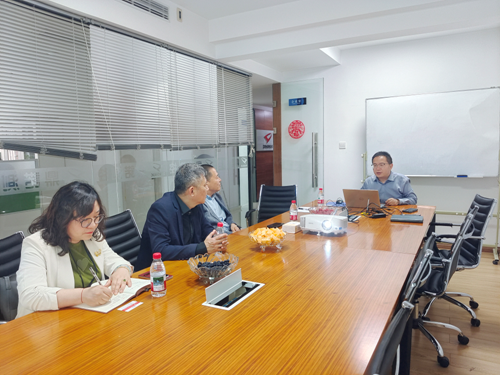
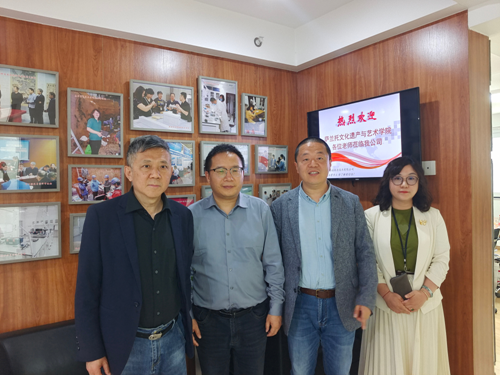
To deepen school-enterprise cooperation and expand graduate employment channels, on the afternoon of April 24, Wang Baohong, Secretary of the CPC Party Committee of An-Lai School, Yang Lu, Dean of An-Lai School, Liu Yuan, Deputy Secretary of the CPC Party Committee, and Hong Dandan, Secretary of General Affairs, visited Xi’an Dingxuan Cultural Heritage Conservation Co., Ltd. and Xi’an Dingnuo Measurement & Control Technology Co., Ltd. to explore collaboration opportunities and boost graduate employment. The two sides held in-depth discussions on talent cultivation, internship programs, and employment opportunity expansion.
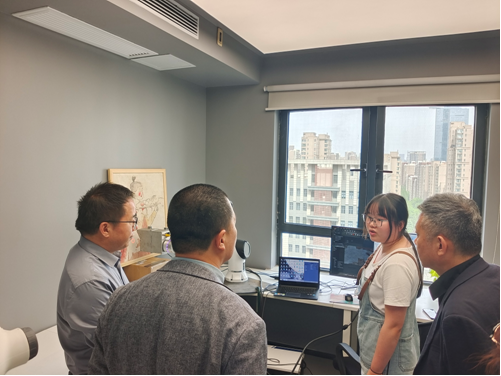
The delegation then observed both remotely and on-site as conservators from Dingxuan Cultural Heritage Conservation Co., Ltd. performed artifact restoration, while exploring potential collaboration in archaeological technology application and cultural relics conservation. Yang Lu emphasized that the school would optimize relevant curricula and enhance students’ practical skills based on employer needs, supporting high-quality development in the archaeology and cultural heritage sectors.
Liu Cunliang, General Manager of Xi’an Dingxuan Cultural Heritage Conservation Co., Ltd. and Xi’an Dingnuo Measurement & Control Technology Co., Ltd., highly commended An-Lai School’s achievements in cultural heritage conservation and historical research. He detailed the companies’ business scope, ongoing projects, accomplishments, and talent requirements. Wang Baohong expressed hopes to establish joint internship bases, providing more practical opportunities for students while cultivating outstanding graduates for the cultural relics conservation and restoration industry, ultimately improving restoration techniques and cultural dissemination to promote Chinese heritage conservation.
This visit has established a sustainable partnership platform between the school and cultural heritage conservation enterprises. Moving forward, An-Lai School will continue aligning with industry demands, precisely identify job opportunities, and inject new momentum into graduate employment and disciplinary development.





 Contact Us:+86-29-88309070
 Address:No.1 Xuefu Avenue, Xi'an Guodu Educational Technology Industrial Development Zone, Chang'an District, Xi'an
 Email:anlaishool@nwu.edu.cn
 西北大学公众号
 安莱学院公众号