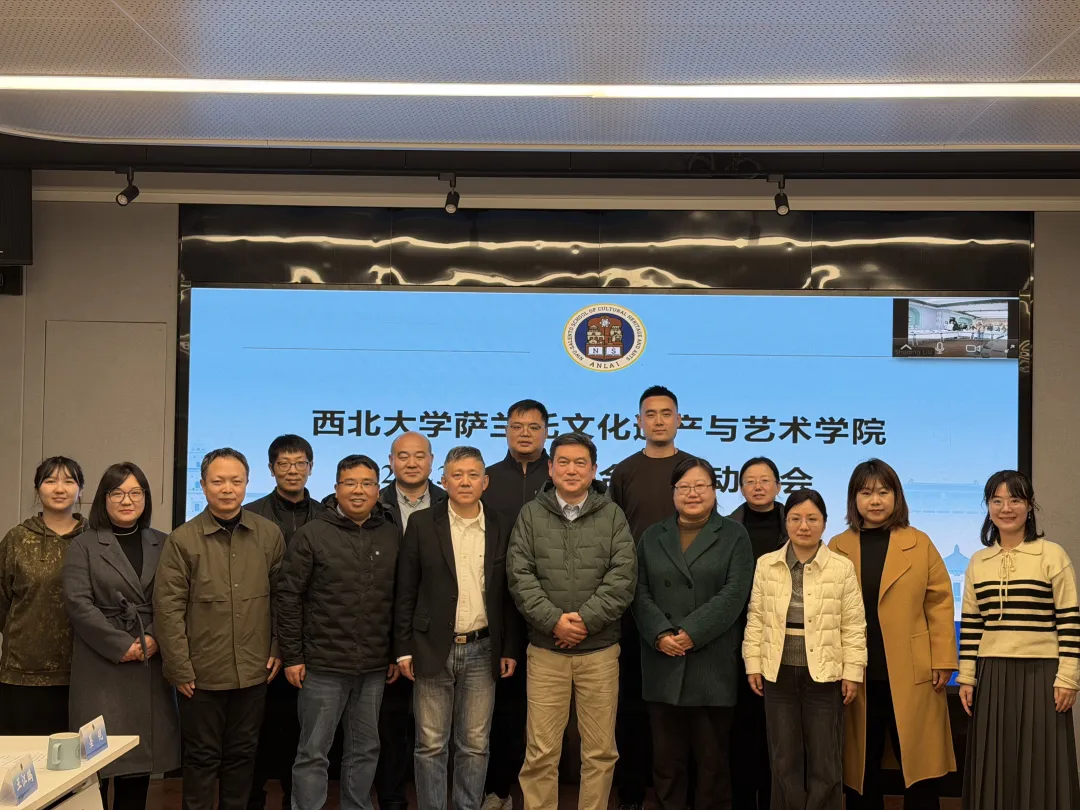
To effectively advance the comprehensive internship program for the 2023 cohort, clarify internship requirements, and ensure practical outcomes, the NWU–Salento School of Cultural Heritage and Arts held a grand mobilization meeting on November 27, 2025. Representatives from partner cultural and museum institutions—including Jin Zilin from the Shaanxi History Museum, He Zhang from the Shaanxi Academy of Archaeology, Zhang Fang from the Shaanxi Academy of Cultural Relics Conservation, Guo Fei from the Xi’an Institute of Cultural Relics Conservation and Archaeology, and Zhang Yue from the Northwest University Museum—were invited to attend the meeting. Also present were the internship supervisors for the 2023 cohort—Liu Cheng, Liu Yan, Zhao Xing, Lan Desheng, and Wang Cong, along with homeroom teacher representative Chen Xin, members of the School’s management team, all students of the 2023 cohort, and representatives of the 2022 cohort. The meeting was chaired by Dou Haifeng, Vice Dean of the School.
After introducing all attendees, Wang Jiangpeng, Vice Dean of the School delivered a systematic address detailing the core goals and value of the internship program. Focusing on the School’s overarching talent cultivation objectives, he provided an in-depth analysis of the critical role of internships within the talent cultivation framework. He emphasized that the internship serves as an essential platform for integrating theoretical knowledge with practical application—and is a key pathway for enhancing professional skills and overall competence. Wang Jiangpeng encouraged all students of the 2023 cohort to make full use of this opportunity, apply classroom learning to real-world work environments, deepen their understanding of disciplinary theories through practice, and comprehensively strengthen their ability to solve practical problems.
Following the speech, internship-base supervisors Jin Zilin, Zhang Fang, Guo Fei, Zhang Yue, and Wang Jiangpeng presented internship certificates to the 2022 cohort students who had completed their internship programs. The certificate serves both as recognition of the students’ achievements and as a formal mark of the official launch of the internship phase for the 2023 cohort.
Ling Xue, the School’s coordinator responsible for NWU courses, then provided a detailed overview of the internship arrangements, offering clear guidance to help students transition smoothly into their internship roles. Subsequently, the internship-base supervisors—Jin Zilin, Zhang Fang, Zhang Yue, He Zhang, and Wang Jiangpeng—explained the core responsibilities, practical assignments, and assessment standards of their respective institutions. Internship supervisors for the 2023 cohort, including Liu Cheng, Liu Yan, and Zhao Xing, further clarified internship goals and performance expectations. Liu Yuan, Deputy Secretary of the CPC Party Committee of the School, delivered important reminders concerning cultural-heritage safety, workplace safety, personal and property safety, traffic safety, and cybersecurity.
The meeting concluded with a summary speech by Wang Baohong, Secretary of the CPC Party Committee of the School. He expressed sincere gratitude to all internship institutions for their strong support, to the supervising teachers for their thoughtful guidance, and to every staff member involved in preparing the internship program. He stressed that the comprehensive internship is a vital opportunity for students to build professional competence, accumulate practical experience, and take an important “first step” from campus to society. He urged students to approach the internship with diligence, humility, and a willingness to learn, cherishing this valuable opportunity for growth. Wang Baohong emphasized that the internship experience is not only a process of applying and deepening professional knowledge but also a process of developing interpersonal skills and personal conduct. He encouraged students to maintain a positive attitude, uphold civility and professionalism, and demonstrate the character and spirit of contemporary youth. He further called on students to work proactively at their respective internship institutions, complete all assigned tasks with high standards, and fully display the strong competence and sense of responsibility that characterize students of the School.
The mobilization meeting clearly communicated internship requirements and disciplinary expectations, ensuring all students have a thorough understanding and conscious awareness of the tasks ahead. With joint efforts and close cooperation between teachers and students, this internship program is expected to yield significant results, lay a solid foundation for students’ future career development, and support their steady advancement within the cultural-heritage sector.





 Contact Us:+86-29-88309070
 Address:No.1 Xuefu Avenue, Xi'an Guodu Educational Technology Industrial Development Zone, Chang'an District, Xi'an
 Email:anlaishool@nwu.edu.cn
 西北大学公众号
 安莱学院公众号